Strength after 40
Creatine after 40: what the research says, and an easier way to take it
It's one of the most studied supplements in the world, yet many people still think of it as something for bodybuilders. Here's what creatine actually is, what the evidence supports, and how to make it part of your day without the powder.

Ask most people to picture creatine and they'll imagine a tub of powder in a bodybuilder's gym bag. It's an image that has kept a lot of sensible people away from one of the most researched supplements there is.
That picture is out of date. Creatine is a nutrient your own body makes every day, and it is one of very few supplements with health claims approved in the UK, including one written specifically for adults over 55 who do strength training.
Why strength matters more with age
From our thirties and forties, we gradually lose muscle and strength, a little more with each decade. It happens to everyone, and it's one reason everyday things like climbing the stairs, carrying the shopping or getting up from a low chair can start to feel harder.
The good news is that muscles respond to training at any age. The NHS recommends that adults do activities that strengthen the muscles on at least two days a week, and that advice holds at 70 just as it does at 30. Lifting weights, working with resistance bands, body-weight exercises such as squats, and even heavy gardening all count.

So what is creatine?
Creatine is a natural compound made from amino acids. Your body produces some every day, mostly in the liver and kidneys, and you take in more from food, mainly red meat and fish. Around 95% of it is stored in your muscles.
Because it comes mainly from meat and fish, people who eat little of either usually get less creatine from their diet.
Creatine monohydrate, the form used in the research and the form in Gummah, is a plain white powder. It is one of the most studied sports supplements in the world, with decades of research behind it.

What the evidence supports
In the UK, health claims on food and supplements are tightly controlled: a brand may only say what has been reviewed and approved. Creatine has two approved claims, and both are worth knowing.
In plain terms: whatever your age, 3g of creatine a day helps you perform better in repeated short bursts of intense exercise, such as sets of lifting. And once you're over 55, if you already do some form of strength training, it can enhance the effect that training has on your strength. It isn't a replacement for the exercise; it works alongside it.
3g a day is the amount both approved claims are built on.
Why so many people give up on it
The trouble with creatine has never been the evidence. It's the routine. Powder has to be measured out, stirred into a drink and swallowed before it settles, and it can taste chalky and gritty. Capsules usually mean several large tablets a day.
And creatine is a daily habit. It builds up in your muscles gradually, so taking it every day matters far more than the time of day you take it. Miss a few days here and there, and it's easy to drift off altogether.
Gummah makes the daily part easy.
Get my 10% code →An easier way: three gummies a day
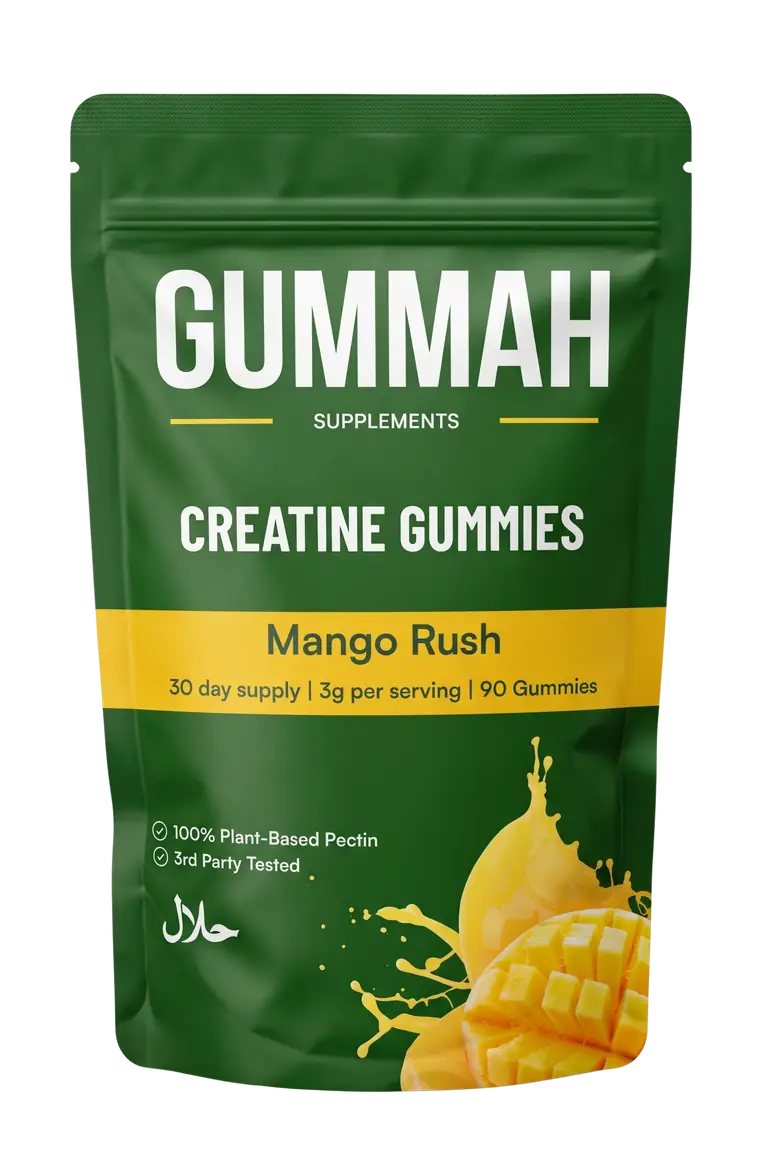
Gummah puts 1,000mg of creatine monohydrate into each fruit gummy. Three a day gives you the full 3g, with no powder to measure, no shaker to wash and nothing large to swallow.
They're made with natural fruit flavouring and come in two flavours, Mango Rush and Fresh Apple. Each pouch holds 90 gummies: a full month at three a day.

A standard you don't have to wonder about
Many gummies are set with gelatin, which is usually made from pork or beef. Gummah uses fruit pectin instead, so it is 100% plant-based, suitable for vegans and fully Halal.
The Halal standard goes further than the ingredient list. It covers the production line, the cleaning, the storage and the packaging too: the whole supply chain, start to finish.
There are no artificial colours or flavours (the colour comes from paprika and carrot), and every batch is tested by an independent lab to confirm the dose on the label.

How Gummah compares
| Gummah | Typical gummies | Powder | |
|---|---|---|---|
| Full 3g daily dose | Often less | ||
| No gelatin | Rarely | ||
| Fully Halal | Rarely | Varies | |
| No mixing or measuring | |||
| Independently lab tested | Varies | Varies |
How to take it
- Three gummies, once a day: at whatever time suits you, with or without food. No water needed.
- Every day: consistency matters more than timing, so tie it to something you already do, like your morning tea.
- No loading phase: a steady 3g a day is all you need, and your muscles fill up over about four weeks.
- During Ramadan: take your three at Suhoor or Iftar.
- Keep up the strength training: the approved claim for over-55s is based on regular resistance training alongside it.

Is it safe?
Creatine has been studied for decades, and 3g a day is a modest, standard amount. As with any supplement, speak to your GP or pharmacist before you start if you have a kidney condition, take regular medication, or are pregnant or breastfeeding.
Gummah contains no declared allergens. It is made without gelatin, dairy, gluten, nuts or soy, and the full ingredient list is printed on every pouch.
Try Gummah with 10% off your first order
Add your name and email and your code appears straight away. We'll send you a copy too, and let you know the moment the first run ships.
Your code is ready.
It's in your inbox too, so you won't lose it.
Use it at checkout on your first order.
Food supplements should not be used as a substitute for a varied and balanced diet and a healthy lifestyle. Do not exceed the recommended daily intake of three gummies. Keep out of reach of young children.
Health claims refer to a daily intake of 3g of creatine; the claim for adults over 55 applies alongside regular resistance training.